Igneous, Sedimentary, Metamorphic: The 3 Rock Types Explained

Geologists sort every rock on Earth into one of three families: igneous, sedimentary, or metamorphic. The names sound technical, but the idea behind them is simple. Each group is defined by how the rock formed, not by what it looks like or what it's made of. Once you understand the three formation stories, you'll start noticing clues in almost any rock you pick up, from a smooth pebble on a beach to a slab of stone in a building lobby.
These three types are also connected. Over long stretches of geologic time, rock material cycles between all three forms as it melts, erodes, and gets buried and squeezed. Geologists call this the rock cycle, and it's part of why the boundaries between categories can blur. Keeping that in mind will help the explanations below make more sense.
1. Igneous Rocks
Igneous rocks start out as molten rock, whether that's magma below the surface or lava that has erupted above it. As the melt cools, minerals crystallize and lock together into solid rock. How fast that cooling happens changes everything about the result.
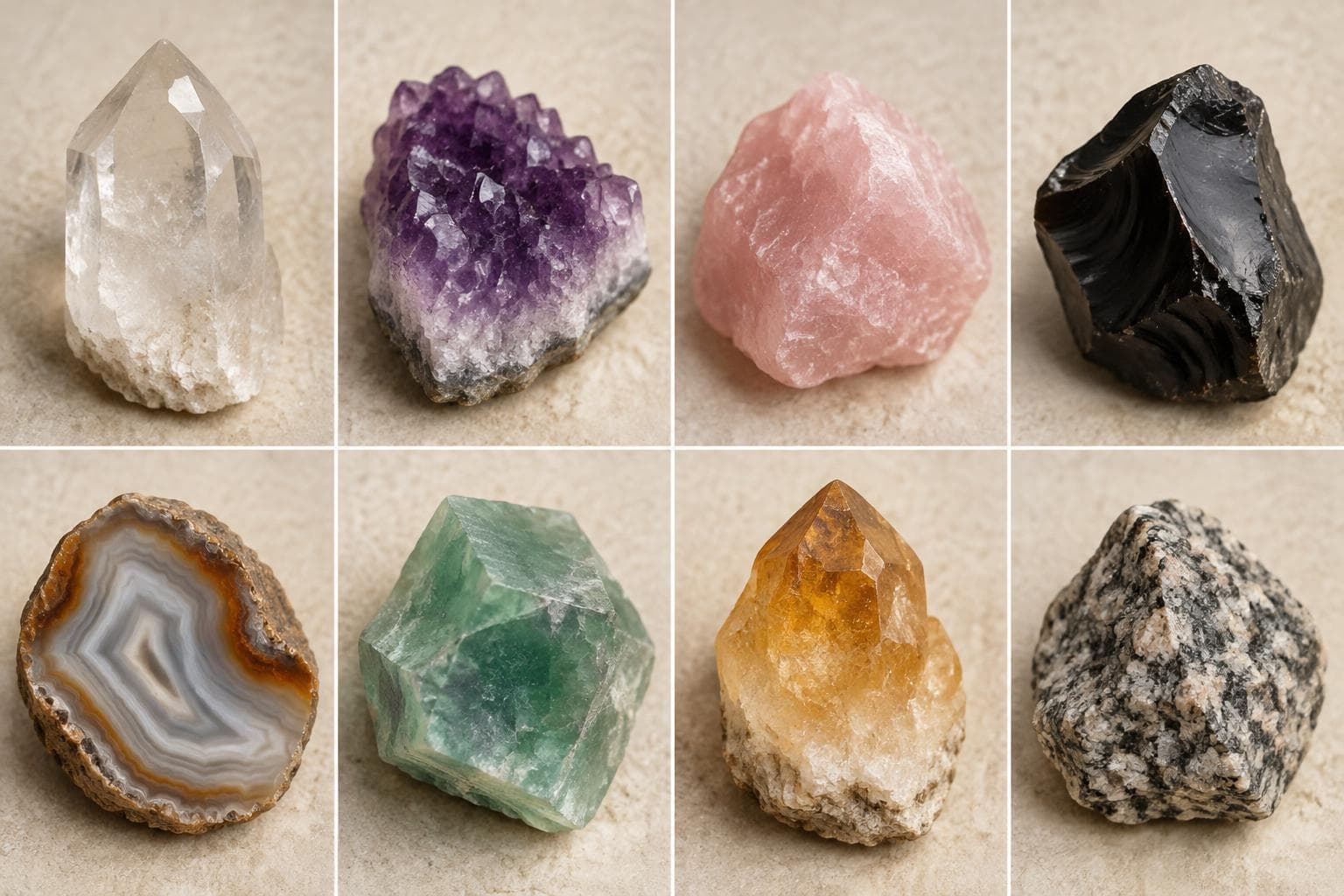
When magma cools slowly underground, over thousands to millions of years, the minerals have time to grow into large, visible crystals. Granite is the classic example: a speckled, coarse-grained rock made mostly of quartz, feldspar, and mica, and one of the most common rocks in the continental crust. When lava instead cools quickly at the surface, crystals barely have time to form. Basalt, a dark, fine-grained rock, is the most common result and makes up much of the ocean floor. In the most extreme case, lava can cool almost instantly, so fast that no crystal structure forms at all. That produces obsidian, a natural volcanic glass with a smooth, glossy fracture.
In the field, look for interlocking crystals with no layering and no fossils. Grain size is your best clue to cooling speed: coarse and speckled usually means it cooled slowly underground, while fine-grained, dense, or glassy usually means it cooled fast at or near the surface.
2. Sedimentary Rocks
Sedimentary rocks form at the Earth's surface, not from heat, but from the patient work of weathering, erosion, and deposition. Wind and water break down existing rock into fragments, carry those fragments somewhere new, and drop them in layers. Over time, more layers pile on top, and the weight compacts the sediment while dissolved minerals cement the grains together into solid rock.
Sandstone forms from compacted and cemented sand-sized grains, often visibly gritty to the touch. Shale forms from very fine mud and clay particles pressed into thin, flat layers that can split apart easily. Limestone forms differently: it's typically made of calcium carbonate from shell fragments, coral, or minerals precipitated out of water, which is why it so often contains visible fossils.
The biggest tell for a sedimentary rock is layering, called bedding, along with a generally softer, more crumbly feel than igneous or metamorphic rock. Fossils are another strong signal, since only sedimentary rocks reliably preserve them. Limestone also reacts distinctly with a drop of dilute acid, fizzing as the calcium carbonate dissolves, a simple test geologists use in the field.
Get Rock Identifier free on iPhone and Android.
3. Metamorphic Rocks
Metamorphic rocks were once something else. They start as an existing igneous, sedimentary, or even older metamorphic rock, and get transformed by intense heat and pressure deep within the Earth's crust, without ever fully melting. That heat and pressure recrystallizes the minerals already in the rock, and can rearrange them into new patterns entirely.
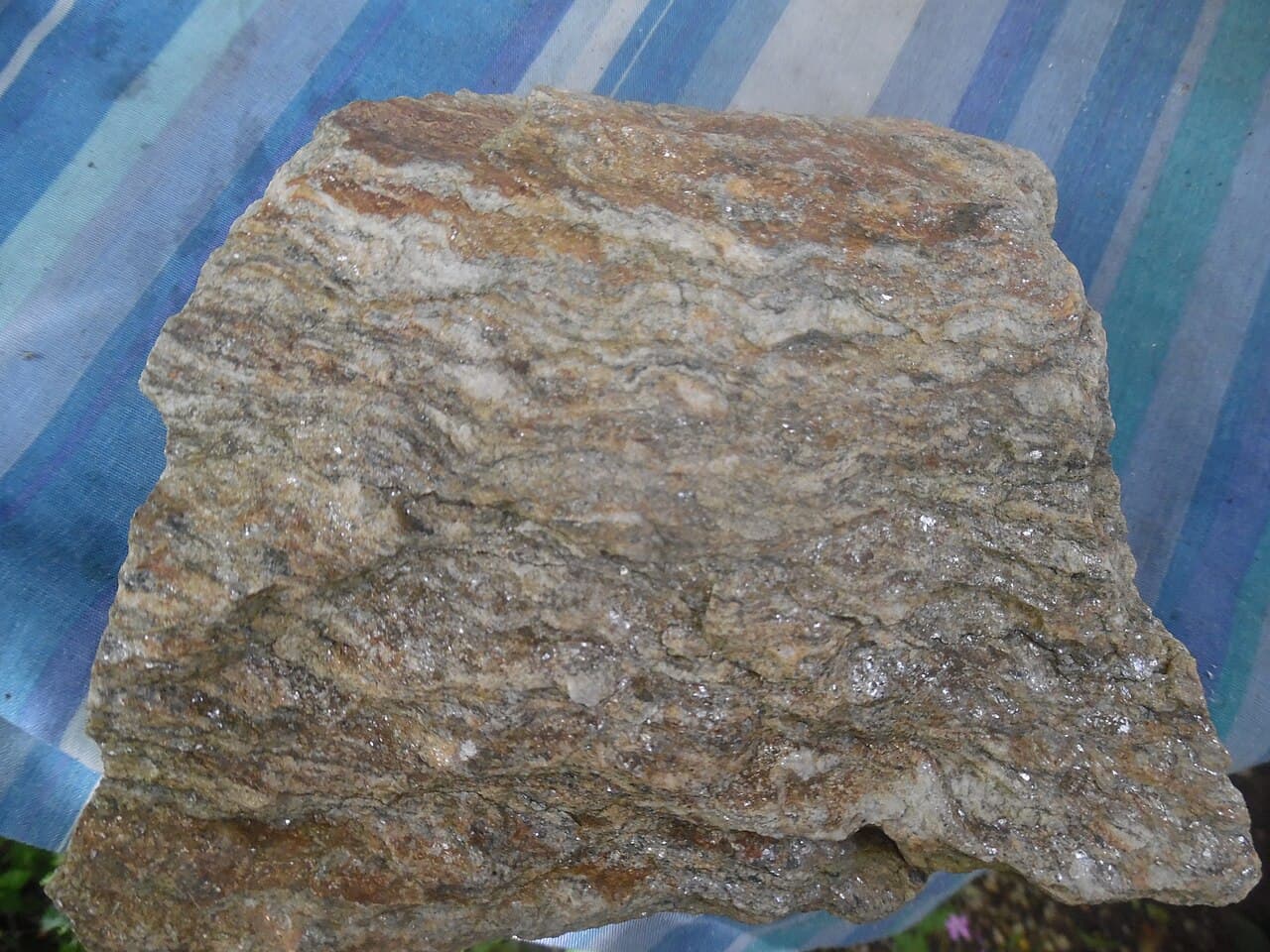
Shale subjected to pressure becomes slate, a fine-grained rock that splits into flat sheets, which is why it's long been used for roofing tiles. Limestone exposed to heat, often from a nearby magma intrusion, recrystallizes into marble, prized for sculpture because its interlocking calcite crystals give it a smoother, more uniform texture than the limestone it came from. Under the most intense heat and pressure, granite can transform into gneiss, a coarse rock where minerals separate out into distinct light and dark bands.
Banding or foliation, alternating layers or streaks of different minerals, is the single best clue that a rock is metamorphic. Slate's tendency to split into flat sheets and marble's sugary, crystalline texture (a step up from limestone's duller, often fossil-flecked surface) are also good field indicators.
4. Putting It Together
Formation story is really the whole game here. Ask yourself: does it look like it cooled from a melt (igneous), does it show layers or fossils from settling out of water (sedimentary), or does it show banding or a recrystallized texture from heat and pressure (metamorphic)? Hardness can help narrow things down too. Quartz and feldspar, common in igneous rocks like granite, sit around 6 to 7 on the Mohs scale, while calcite-rich rocks like limestone and marble sit around 3, and mica-rich rocks like slate and schist can be softer still. Sources vary somewhat on exact rock hardness since a rock is a mixture of minerals rather than a single substance, so treat these as rough ranges rather than fixed numbers.
None of this requires lab equipment. A loose sense of texture, layering, crystal size, and what the rock is made of will usually get you to the right family. From there, a clear, well-lit photo of the surface and a freshly broken edge is enough to narrow things down to a specific rock or mineral. Snap one next time you're out, and let the identification app in Rock Identifier take it from there, or drop it straight into your Collection to keep building out your own field notes.